Root Cause Problem Solving, without the paperwork theatre.
RCPS is how a site stops fixing the same failure every month. This guide covers the methods that actually get used, why investigations stall, and what a working case looks like.
Root Cause Problem Solving (RCPS) is a structured investigation method manufacturing sites use to find and eliminate the underlying cause of a failure rather than repeatedly treating its symptoms. A case gathers evidence with 5 Whys, Fishbone, Is/Is-not, Timeline and FMEA, and is complete only when it ends with a confirmed cause, corrective actions, and named owners with due dates.
What is RCPS?
Root Cause Problem Solving (RCPS) is a structured way of investigating a failure until you reach a cause you can act on — not the first plausible explanation, and not the person nearest the machine. A real RCPS case ends in three things: a cause, actions, and owners. If a case ends without all three, the failure is coming back.
Most manufacturing sites already run some version of this under different names — 8D, A3, incident review, "the deep dive". The label matters less than the discipline: evidence attached to the case, a method that pushes past symptoms, and actions that survive the meeting.
The methods that actually get used
5 Whys
Ask why the failure happened, then ask why again, until the answer is something you can change. The trap is stopping at a "possibly" — "possibly the seal was worn" is a hypothesis, not a cause. Good facilitation keeps asking for the evidence.
Fishbone (Ishikawa)
Lay out candidate causes across categories — machine, method, material, people, environment, measurement — so the room considers the whole space instead of anchoring on the first idea.
Is / Is-not
Define the failure's boundaries: where it happens and where it doesn't, when it started and when it doesn't occur. The sharpest tool for killing bad hypotheses early.
Timeline
Reconstruct the sequence — alarms, interventions, changeovers, handovers — before memory rewrites it. Half of all root causes are visible in the timeline alone.
FMEA
Failure Mode and Effects Analysis ranks how each component can fail and what it would cause. If your site keeps a FMECA on the asset, the investigation should start from it, not rediscover it.
Why investigations die in spreadsheets
The usual failure mode isn't the method — it's the medium. The 5 Whys lives in a slide deck, the timeline in someone's notebook, the actions in a spreadsheet nobody reopens. Three weeks later the case is "closed" because nobody can find it. The asset's history — past breakdowns, past investigations, the FMECA — sits in other systems, so every case starts from zero.
How an RCPS case runs in Lumen
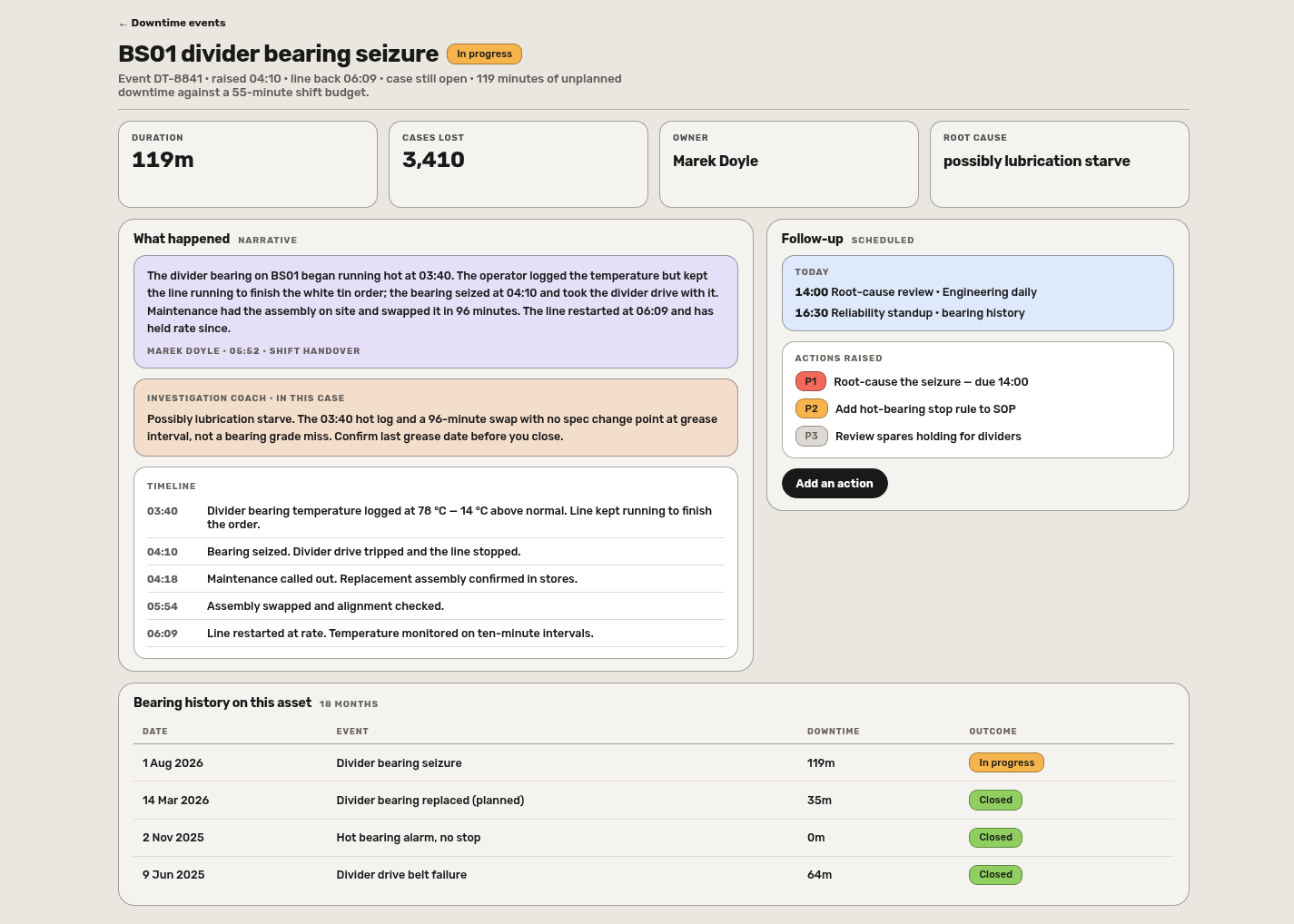
In Lumen, a case opens on the failure and stays on the asset. The evidence sits on the case — 5 Whys, Fishbone, Timeline, Is/Is-not, FMEA — alongside everything already known about that asset from the same reliability tree: its issues, its downtime events, its FMECA. An Investigation Coach reads the 5 Whys as it's written and pushes back while a cause is still a "possibly", asking for the evidence.
The case walks a visible path — Draft → Assigned → In progress → Pending review → Awaiting actions — and the actions it raises land on the same work board the site already runs the day on, each with an owner and a due date. Nothing to re-type, nowhere for the case to hide.
What does RCPS stand for?
How is RCPS different from 8D or A3?
When should a site open an RCPS case?
Who should own an RCPS case?
See it on a running site.
Let us show you what Lumen would look like in your facility.