Short-interval control: catch the miss while the shift can still fix it.
SIC is the discipline of checking performance against plan every hour or two — and acting inside the shift — instead of discovering the miss in tomorrow's report.
Short-interval control (SIC) is the practice of checking production output against target at fixed intervals — usually every one or two hours — and acting inside the shift when an interval misses. It shortens the feedback loop so a miss costs one interval rather than the rest of the shift, and it depends on live data, owned countermeasures, and connected escalation tiers.
What is short-interval control?
Short-interval control (SIC) breaks the shift into intervals — typically one or two hours — and compares actual output against target at every interval. When an interval misses, the team responds inside the shift: a countermeasure, an escalation, or an adjustment to the plan. The alternative is finding out at 6am that yesterday died at 2pm.
The principle is old and unglamorous: the shorter the feedback loop, the smaller the loss. A missed interval caught at the next check costs you an hour. The same miss caught in the morning report costs you the rest of the shift, plus a meeting arguing about whose number is right.
The cadence that makes it work
- Every interval: the line lead checks actual vs target. A miss gets a reason and, if it repeats, a countermeasure with an owner.
- Start of shift: the briefing — last shift's breakdowns and handed-over downtime already on the board, not read out from memory.
- Daily: the area review walks yesterday's intervals, confirms countermeasures landed, and opens an RCPS case where a failure needs more than a countermeasure.
- Weekly: the site weekly compiles the week's downtime, plan conformance and open actions — numbers agreed before the room sits down.
What a good SIC board shows
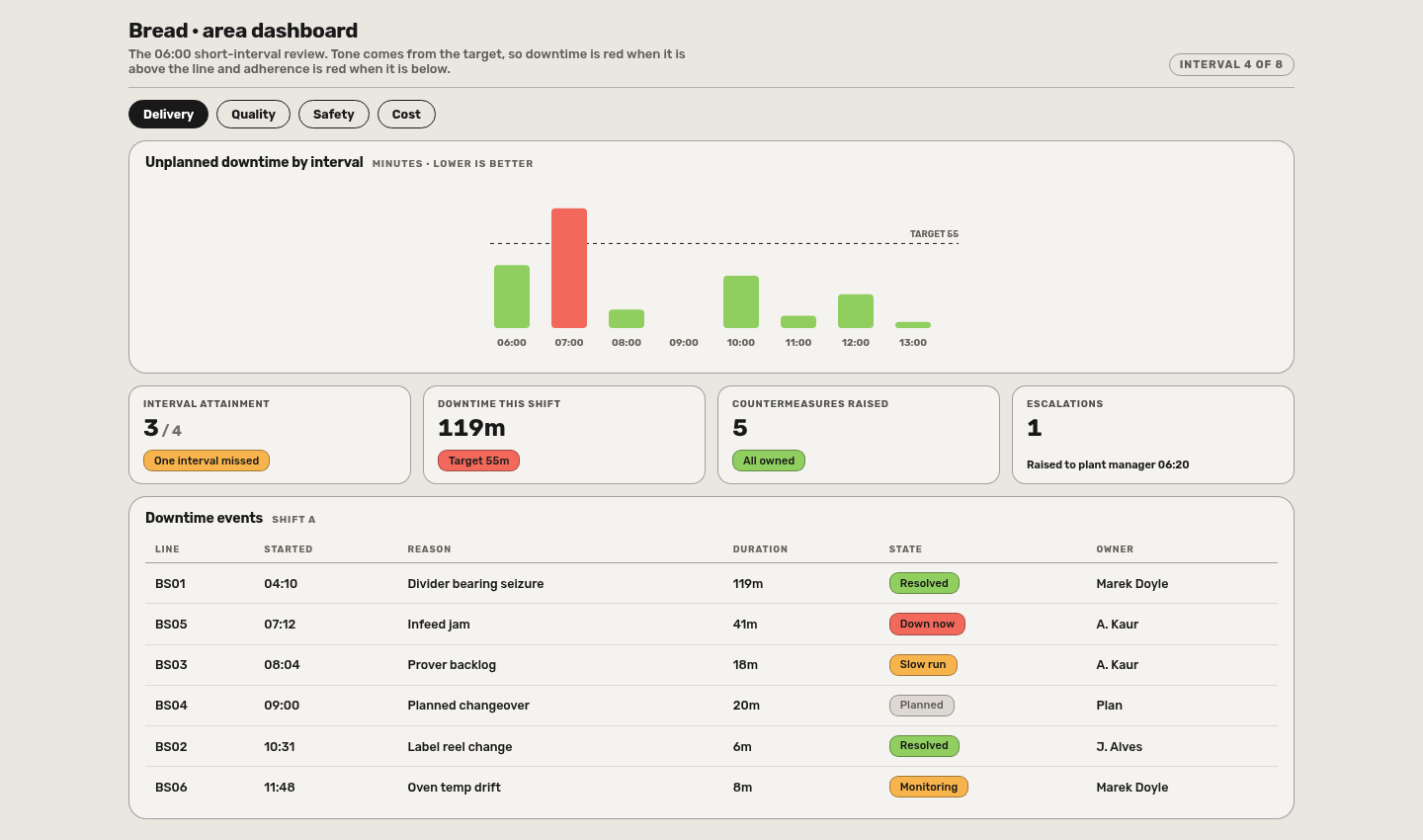
A working board answers four questions at a glance: are we on plan, what took us off it, what are we doing about it, and who owns that. Concretely: unplanned downtime by interval against target, interval attainment, the countermeasures raised, and the downtime event table underneath — every event with a reason, a duration and an owner.
Where SIC breaks down
Three failure modes account for most dead SIC programmes. The board is re-typed — someone copies numbers from the historian into a whiteboard or spreadsheet, so the board lags reality and the room debates the transcription. Misses have no owner — reasons get logged, nothing gets assigned, and the same interval misses next week. The tiers don't connect — the shift board, the daily pack and the weekly deck are three separate documents that never agree.
SIC in Lumen
In Lumen, the SIC board reads from the systems the site already runs, so the interval data is live — nothing re-typed. A miss becomes a countermeasure on the work board with an owner and a due date. And because briefings, the daily review and the site weekly all run on the same board, the tiers connect by construction: the number the shift saw at 10am is the number the weekly sees on Friday.
What interval length should we use?
Is SIC the same as an OEE dashboard?
Do we need new sensors or an MES to run SIC?
Who runs the interval check?
See it on a running site.
Let us show you what Lumen would look like in your facility.